
A Merely Adequate Saint
A Medieval French King Teaches us to Expect More

When people abroad ask where in the United States I am from, I assume they probably won’t know Columbia, Missouri. So I say “near St. Louis.” It’s not true if you’re looking at a map of Missouri, but it’s true enough if you’re looking at a map of the United States. At any rate, St. Louis is our “big city.” Our exciting weekend trips occasionally took us to Kansas City to see the Royals or go to Worlds of Fun, but the more frequent and preferred destination was St. Louis, the Cardinals, the Magic House, the Arch, the Zoo, and Italian in more grease than should be legal in a neighborhood known as The Hill.
I love it, somewhat narcissistically, because it reminds me of myself. It’s in the middle of everywhere, but doesn’t quite fit anywhere. Like all of Missouri, St. Louis seems southern if you’re coming from the north, and northern if you’re coming from the south. It experienced the blow of white flight to the suburbs, and now suffers from gentrification as the white folks come back. It did not rise to the occasion when Michael Brown was murdered in 2014 and in the unrest that followed. And yet I know such radiant spots of life, resistance, and justice-seeking there that I cannot give it up for hopeless. A lot of my college friends are either from there or moved there. Part of me always hoped I would too, though that seems pretty unlikely at this point.
A lot of what I say about the city could also be said about the saint for whom it is named, the French king Louis IX (1226-1270), who is commemorated today in Episcopal churches and others that do saints.
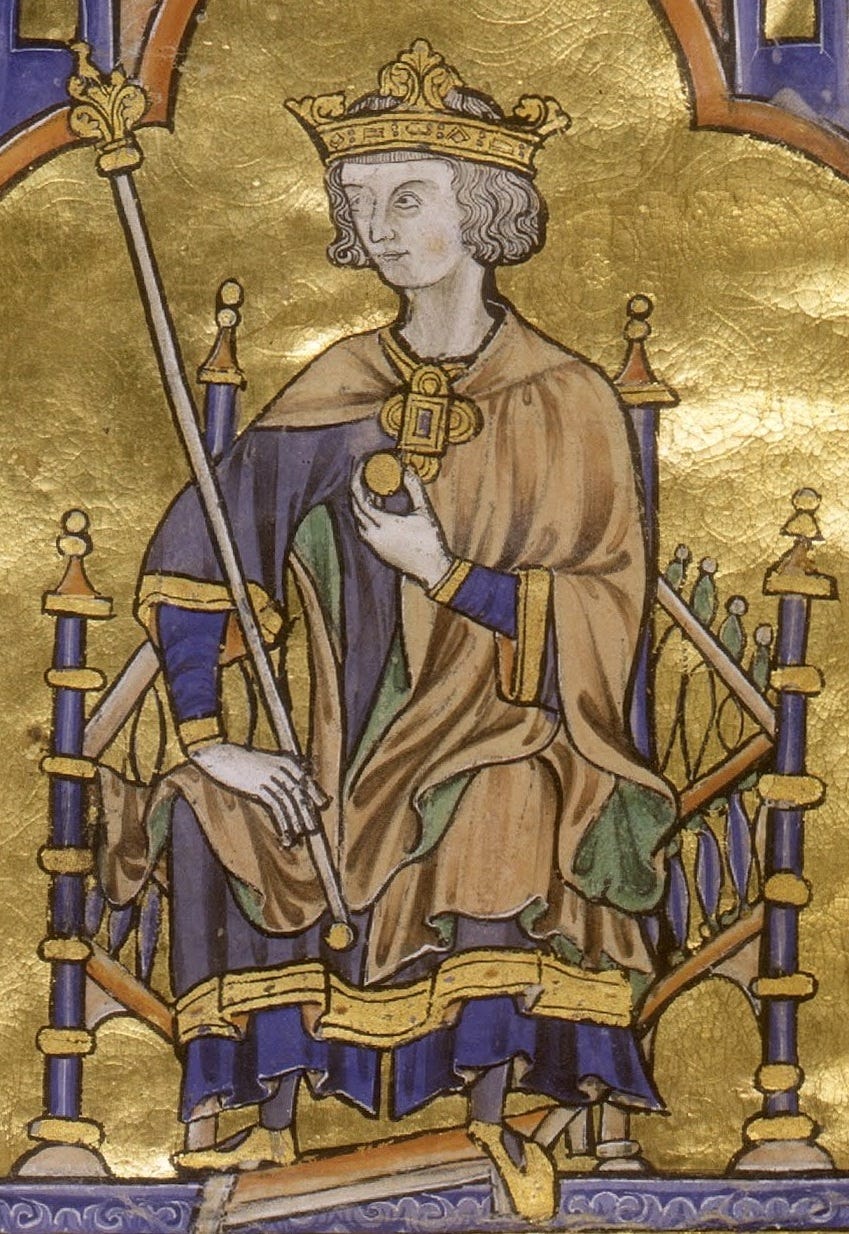
I doubt we would canonize Louis today.1 We are rightly unwilling to pass over certain sins that were not seen as such a big deal in other ages (if they were seen as sins at all). Louis put his signet on the repression of the Jewish community of France, and also went along on two crusades. He was captured on the first and got sick and died on the second, but seems to have been protected by grace from having his participation in that foolishness register as historically significant (real medievalists may feel free to correct me; everything I know about him is from textbook hagiographies and Wikipedia, or what I happen to remember from high school). Still, I am glad that somebody else canonized him in another era. Calling him a saint does not mean we excuse his sins. Short of the Blessed Virgin Mary (on some accounts), the saints all sinned, and sometimes with serious import for the direction of the world.
There are not a lot of ruling monarchs or other heads of government among the canonized saints, even from ages that were generally more forgiving of their leaders than we are of ours. It is not news to us that innocence is not really an option for most political leaders, royal or elected. They have to work with the world they live in. At best, they allow some evils in order to prevent others, inhibit some good for the sake of other good, using the best lights available to them, and rarely with judgment that is entirely vindicated by hindsight. Things are rarely at their best, of course. Most are given to interests that they are not even entirely aware of, subject to the general moral and intellectual infirmity of our fallen condition. And they have whatever particular flaws and temptations which may not be worse than those of others, but whose effects are amplified by their positions. At best, we may forgive rulers; but we do not look for saints among their ranks. That is mostly well and good.
Except that our cynicism has been abused. Fine, we don’t expect many saints among the kings and presidents of the world. But we apparently also don’t expect the presidents and prime ministers of the world to even try to be saints. Trying to be a saint is what you’re supposed to do as a Christian, not a unique requirement for a ruler. Every single one of us knows we cannot do it by our own power. Far from heroic virtue, mere adequacy is beyond us except by grace. Saintliness is a miracle. But we have faith in Christ. We are supposed to live as people who expect miracles, indeed the miracle of sanctification.2 But as a first step, if we dare not yet pray for and expect sanctity by the grace of God, can we least pray for God’s grace for ourselves and our rulers to be minimally adequate? And can we stop excusing our rulers’ avowed unwillingness to pursue minimal moral adequacy in their personal and official dealings? It is a complete non sequitur that that if we can’t realistically demand that they be philosopher-kings, then we can’t demand that they not be monsters. They can still be accountable to God and the human community. And while the saint-king may not look like the saint desert ascetic, we do have St. Louis and a few others as models to which we can aspire.
Louis was known for his prayer, and that’s a good place to start. I say it again: there is no health in us, and we can hope for sanctity or even adequacy only by grace. But we believe in this grace! God can not only forgive our sins, but cleans us from every sin, make us people who do not sin. If you’d prefer Augustine, God can grant what God commands. If you’d rather Wesley, the faith that sanctifies is the same as the faith that justifies, and we should expect it in this life. We are to long for it, pray for it, try to live like it’s a reality, and confess our sins and cast ourselves on the mercy of God when we fail (again). It’s not like you have anything to lose! And then we can at least frickin’ try to examine our personal and social consciences, resist what evils and do what good we can. At least sometimes God gives the grace to not screw everything with any exceptional success (as is the case with Louis IX’s idiotic crusades), and maybe even to make the world a little more just and such welfare as this age affords a little more equitably shared (as with Louis’ reforms of the French justice system and his relatively successful attempt to get people to kill each other less often). For the Talmud burning, he will just have to beg forgiveness. Calling someone a saint is a statement about what God actively works through a person, and also what God forgives in a person.
Human rulers have sufficiently cooperated with God that their holiness shapes a few things for the better, and that their sins are at least not any worse than what is normal for their age. Maybe not a lot really hangs on whether we call them saints or not. I just hope that Louis and others have shown us that our suspicion of politics and politicians should stop far short of calling them hopeless and therefore unaccountable. Indeed, we may have hope in God that even politicians can and will be saved, can and will be saints. And we are all political animals.
From The Episcopal Church’s Lesser Feasts and Fasts:
O God, you called your servant Louis of France to an earthly throne that he might advance your heavenly kingdom, and gave him zeal for your church and love for your people: Mercifully grant that we who commemorate him this day may be fruitful in good works and attain to the glorious crown of your saints; through Jesus Christ our Lord, who lives and reigns with you and the Holy Spirit, one God, for ever and ever. Amen.
Thanks for reading this short reflection on something merely adjacent to my expertise. You might also like the essay I wrote earlier this week on something I actually do something about. If you’re enjoying these, please share that post, this one, or the substack, and subscribe if you haven’t (buttons below).
Granted, Anglican churches don’t generally canonize anybody anymore (since we don’t generally believe in purgatory, it doesn’t make as much sense to certify that someone is in heaven).
You can take the boy out of the Methodist circuit, but you can’t take the Methodist circuit out of the boy.