
Learning Languages and Creating Worlds
Undermining language study at a university is treason!

On the surface level, it would seem that enabling the cost and human labor in learning and teaching language is exactly what AI ought to be good for. But on a deeper and more important level, learning language and translating them is about learning to live in multiple words at once. At the University of Chicago, I had the honor of studying the Bible and other texts with masters of the ability to more and translate among the worlds of various languages. I will likely never have the level of mastery of any languages that my professors in Bible and classics did. But having experienced it, and having done the best I can with the languages of people I have come to love in Europe and Asia, I can confidently say that teaching and translating languages on anything but the most superficial level is the last thing I would entrust to a machine.
When I heard of the desires of administrators at my university concerning the future of language programs there, I receive it not as tragedy, but betrayal. The Humanities Division, which has significant overlap with the Divinity School (where I got my MDiv and PhD), is likely suspending admissions to all of its graduate programs requiring language study in the following admissions cycle. As if this isn’t bad enough, the administrator who emailed department chairs to announce the freeze went on to tell them that they needed to begin proposing languages that could be eliminated and which ones could be taught by AI. Maybe they will distance themselves from this, especially the AI part.1 But the assumption is clear: languages do not matter like they used to because everyone who matters learns English, and there’s Google and AI for everything else. I was not in a language program at Chicago, but one reason I went there was because I its language and literature programs are among the best in the world. I saw it as a place where people shared my curiosity about languages.
Languages matter because words create worlds. We speak and think and (if we’re scientists or other scholars) do rigorous scholarship in one or more languages. Without being to engage any other than our own, we will never understand the possibilities and limitations of the very medium of our thought. Sacrificing our curiosity about the worlds our language and other languages create and actively underming language study in our universities is treason, not a strategic disagreement.
Do we need to study languages now that we have AI?
Look at these two sentences:
“My sister came and asked to borrow some sugar.”
“Adikku datang dan minta meminjam gula.”
That is Indonesian, and either of these two sentences could be said to be a perfectly adequate translation of the other. And yet:
1.) The English sentence tells you the gender of my sibling, but not whether she is older or younger. The Indonesian tells you that the sibling is younger, but not their gender. I could specify gender if I wanted to, but hiding the age would require an awkward construction.
2.) The English sentence tells you that a single sister did the arriving and asking. The Indonesian sentence does not specify whether the subject is singular or plural. Indonesian nouns and verbs do not have number.
3.) The English sentence is in the past tense, but Indonesian verbs do not have tense any more than they have number. Gender, number, and time are all allowed to remain unspecified.
4.) The English sentence says little or nothing about my relationship to you, but the Indonesian sentence indicates that we're on quite familiar terms (or that you are a child), because the suffix I added to adik corresponds to the familiar form of I, aku. I could have said adik saya if I had wanted to be less familiar. Or there is always the third person, adik Kyle. The third person is a very normal way of referring to either yourself or the person you’re speaking to, and is probably as close as you can get to status neutral. But then you have either use your proper name, or you will probably use an honorific of real or fictive kinship, specifying a relationally that is entirely optional in English (in fact, it somewhat difficult to convey).2
My first response upon learning all of this when I first encountered Indonesian over a decade ago was “then how do you know whether they mean one or several, today or yesterday”? And I answered my own question: “either context makes it clear, or you supply it with extra words.” Just like in English, I can clarify that it was my little sister who came, if I think it’s important. And this is true. But what’s interesting about this is not whether you can make time, number, and gender explicit in Indonesian (of course you can). Every language comes up with ways to supply any perceived lack. The question is: what is perceived as a lack? What kind of world do I live in if the sentence seems incomplete to me without identifying time, number, and gender? What sort of world does my conversation partner live in if the sentence seems incomplete if it doesn’t somehow locate the speaker, hearer, and person being discussed in a web of relationships?
Learning Indonesian as an English-speaker is not about how to decipher an encrypted message. It is about learning to live in a different world, at least to some extent. You might bristle at some of that world’s characteristics, but you want to be able to move in it somewhat competently. Or even if you do not become very fluent in the language and never develop much of a sense of the world it communicates, there is value to trying and failing, and learning that the world is there. Many Indonesians, especially younger and urban folks, have at least some proficiency in English, and they will probably adapt to your language and your world as they are able. Their reputation for hospitality is well-earned. But even if there may be no feasible way to make the adaptation more mutual, it is at least worthwhile to try to get a sense of how much work and adaptation they are doing, so you can be properly grateful.
We can also critique the worlds we visit and receive their critique or ours. As the great (and I do mean great!) scholar of Southeast Asian languages, Alton Becker, once remarked (I’ll have to paraphrase since I don’t have the book with me), an English speaker probably learns about the levels of politeness in Javanese (much more pronounced than in Indonesian) and thinks that Javanese people are obsessed with status and hierarchy, but a Javanese person would look at English and think that English-speakers must be obsessed with quantity, gender, and time. It is not necessarily good or bad, but it is true. We do not notice how intrinsic yet utterly contingent these things are in our worlds because of how deeply they are encoded in English and most of the languages of Europe (and all of the colonial languages). Either of these implicit obsessions can have better and worse expressions. Our classifying and quantifying, our conceit that we control time, is as bad as any stratified hierarchy or caste that Geertz claimed to have found in Java or Bali. And if our visits to one another make us aware of things we take for granted but perhaps should not, then we have yet more cause to be grateful that we learned another language, or that someone else learned ours.
Translation apps have their uses. One time in Amsterdam, I helped a lost woman from Kyrgyzstan using Google, even though she had no English or Dutch and I had no Kyrgyz or Russian. If you want to eat in Indonesia, you can speak your order into a machine, which will then produce a mechanical voice saying in understandable Indonesian that you want fried rice with chicken—not too spicy—mango juice without ice to drink, and you’d like to pay by card if possible (it probably isn’t). But even though you (or your phone) will have used Indonesian words, but Google will see to it that it is an American interaction. You will not have dwelt in the world of the Indonesian language at all. Google Translate and ChatGPT have only made learning Indonesian obsolete if the only thing you want to do in Indonesia is make transactions, and entirely on your own terms.
And God said…
Words create worlds. God created the world with words. Other creation stories that the communities that wrote Genesis 1 may have known involve the gods creating the world through combat. They killed their mother and made the world out of her carcass. But in the Bible, God creates the world through communication.3 As soon as there is a human being, the first thing God does is have this human being continue God’s work of creation by giving names to all the other creatures. Human beings communicate, and when they do, they adorn and maybe even complete God’s creation. Human beings create worlds too, and different ways of communicating create different worlds. We offer those worlds back to God when the very Word by whom and in whom God created all things invites us to address the Source of all things with him as our Father.
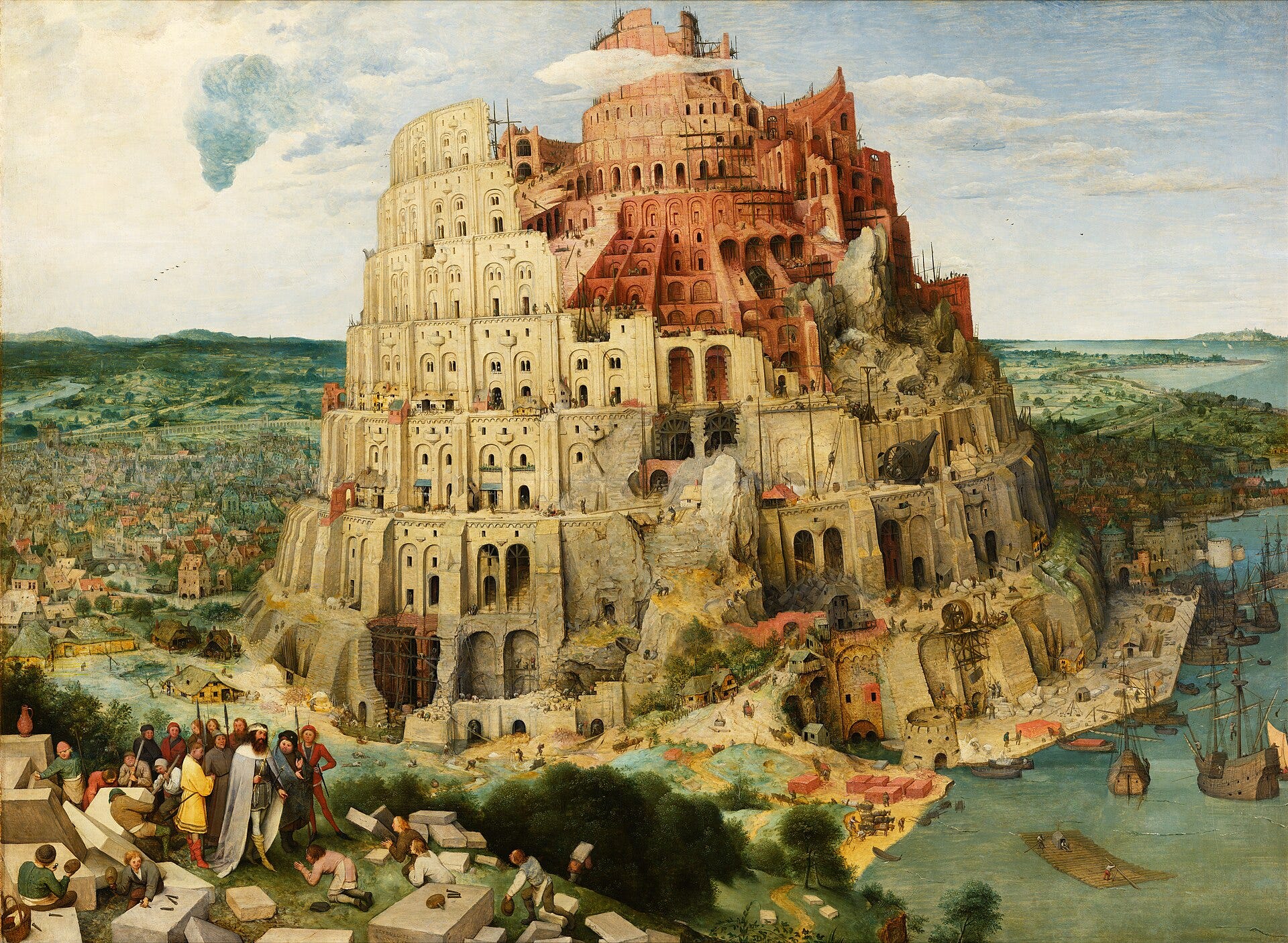
Those who tell us that we do not need to learn languages anymore because everyone can use the apps are often enough the same people who imply or even state that everyone in the world has already learned English, or should. No need to learn how to be a guest in their worlds, they seem to say, because all the worlds are collapsing into one. I wonder if they notice how similar the situation they imagine is to the Tower of Babel. In case you need a refresher: after the Great Flood, all of humanity lived in one place and spoke a single language. Then they got it into their head to build a tower. God goes to see it and says (to someone), “Come, let us go down and confuse their language there, so that they will not understand one another’s speech” (Genesis 11:7). The genius of Genesis is that it leaves so much unspoken and unexplained (this observation, now classic, has held up pretty well in my opinion). So the last thing we should expect from the narrator is an explanation, and none is given.
But I have long wondered, particularly given the location of this story (“the plain of Shinar,” thus the heart of the Babylonian empire that would come to dominate the Biblical world), if it is less an indictment of human beings’ presumption to do something great, and more a warning that human beings and their languages are not meant to be interchangeable with one another. In one sense, we all share the world that God has created and do our own creating within it (“sub-creation," Tolkien called this). But the worlds we create within God’s creation are real. We are meant to live in different worlds, perhaps multiple different worlds, and to extend and receive hospitality.
Christians often pair moments in the New Testament with events in the Old Testament which they are said to heal, reverse, or complete. This is called “recapitulation.” The miracle of Pentecost is then paired with the Tower of Babel. I think this is insightful, but look carefully at what happens. When the Holy Spirit is given to the disciples gathered in the upper room and people from all over the world suddenly find themselves addressed, it is not because everyone has started speaking one language. The miracle is not uniformity, the collapse of all language and all worlds into one, but communication in multiplicity of languages and worlds. It was uniformity, all communication and all cultural endeavor on one set of terms, that is healed at Pentecost.
True, “tongues will cease," like knowledge and prophecy. The worlds we create within God’s world are all partial expression of the creative mind of God. And “when the complete comes, the partial will come to an end.” It it not revealed whether this means that everyone will become everything, or whether languages we create or a transformation of their character that renders all our present conceptions of harmony and discord meaningless. Or at least it is not revealed in a way I understand. But whatever it is, it is not a human technological achievement. Whatever will happens will happen when Christ presents all things to the Father, and God will be all in all.
Do not think that communication and difference will be undone even then. If you are a Christian, multiplicity is found even in the oneness of God. God communicates with Godself, and salvation in Christ is our inclusion in that communication. In this age, if you dishonor language and try to collapse difference, you sin against both the order of creation and the order of redemption.
This is Christian and theological, of course. Just this once, you have my permission to take it all as a metaphor, if you like. If you find the metaphor halfway compelling, then I hope you will also agree with me that the ways human beings communicate are a worthy object of study. And when I say “the ways human beings communicate,” the main thing I am talking about is language and, specifically, languages. Not everyone will or can a foreign language to the point of fluency, and not every scholar needs to specialize in foreign languages, linguistics, or literature. But every scholar does whatever they do using language, and not just language, but a language (well, if they’re Swiss, they can probably manage two or three). To learn another language, even a little, or even to have tried and failed, is to be a little less ignorant about the world you are creating and how it interacts with other worlds that others are creating, and maybe even with God’s world of worlds.
At any rate, thank you for visiting my very Christian linguistic and symbolic world for a few minuntes. Let me offer you one more thing before you go.
Leaving Without Betraying
A few people over the years have told me that they no longer believe. Being a believer and a lover of this tradition, I do experience this as a bit tragic, but not as wrong or evil. Apostasy does not mean the sense that as you grow, your religion no longer fits. The Greek word means rebellion. It is only apostasy if you are a complete jerk about it, if you cannot at least acknowledge and honor the love that moved a community to hand something onto you, even if the thing itself is not quite the right thing for you.
All of us who get PhDs learn that the university will never love us back. Like many of my friends, I decided to seek my livelihood elsewhere. Those who stay have to deal with the fact that the pathologies of institutions and the economies that support them are largely at odds with the thing they claim to love. I would not hold it against anyone who decided that the battle for German and Greek at their university is not their fight anymore, or that they do not love this way of exploring the world they way they used to. Go your way in peace if you wish. But do not do the devil’s work for him on your way out. You can lose your faith without betraying it.
I did not do my bachellors degree at Chicago, so I never experienced the famed humanities core, several versions of which include The Divine Comedy. I confess I only reacently read it, but it is quite relevant to the present discussion. The uppermost level of hell as Dante imagines it, barely hell at all, is the home of those damned by tragedy. They were as righteous as it was possible to be without redeeming faith. Language abounds: it is where most of the great classical poets ended up. As Dante and Virgil descend through the realms of those damned by passion, violence, and deception, the language becomes more self-centered, more incoherent, words gradually give ways to nonsense and shrieks. Only the nethermost circle is without language at all. There, the damned are frozen in ice. Having deprived themselves of any curiosity about others and their words, they are deprived of any divine or human communication. This most final and only true damnation is the punishment for treachery.

Nothing has been announced, but it is being discussed quite openly on social media among alumni, faculty, and friends of the university. I am not going to share screenshots or name names myself, but my channels are reliable. I hope that the parties in question will at least have enough shame to disavow the words being shared and step back from at least the worst of the policy. I suspect there will just be a euphemistic repackaging of it. But if you who read this are a U of C university or humanities division administrator, please prove that this is vicious slander by announcing that graduate study in all humanities departments will continue, that no languages will be eliminated, the faculty you’ve been dragging along without tenure will be given tenure, and that positions that have remained empty or been eliminated will be restored and filled. Easy as that! [Accidentally deleted this footnote in the version that got sent out by email. Oops!]
If that seems complicated, just be glad I opted for Indonesian instead of Javanese (I have taken some Javanese classes, but calling my proficiency “basic” would already be generous). Indonesian is a standardized register of Malay as it was spoken as a trade language in Java in the era of the Indonesian independence movement and is fairly westernized or Indo-Europeanized. Javanese is the same as Indonesian when it comes to tense, number, age, and gender, except that even pronouns don’t have number (so it could be “my younger sibbling[s]” or “our younger sibbling[s]), almost every word would show you something about the relative status of you, me, and whoever or whatever we’re talking about, and the verbs might not have a subject at all.
Andrew Decort, my fellow University of Chicago Divinity School alumnus, is the first person I remember putting it quite this way.